
August 22, 2026
How to search any chess position across millions of tournament games
Andrew
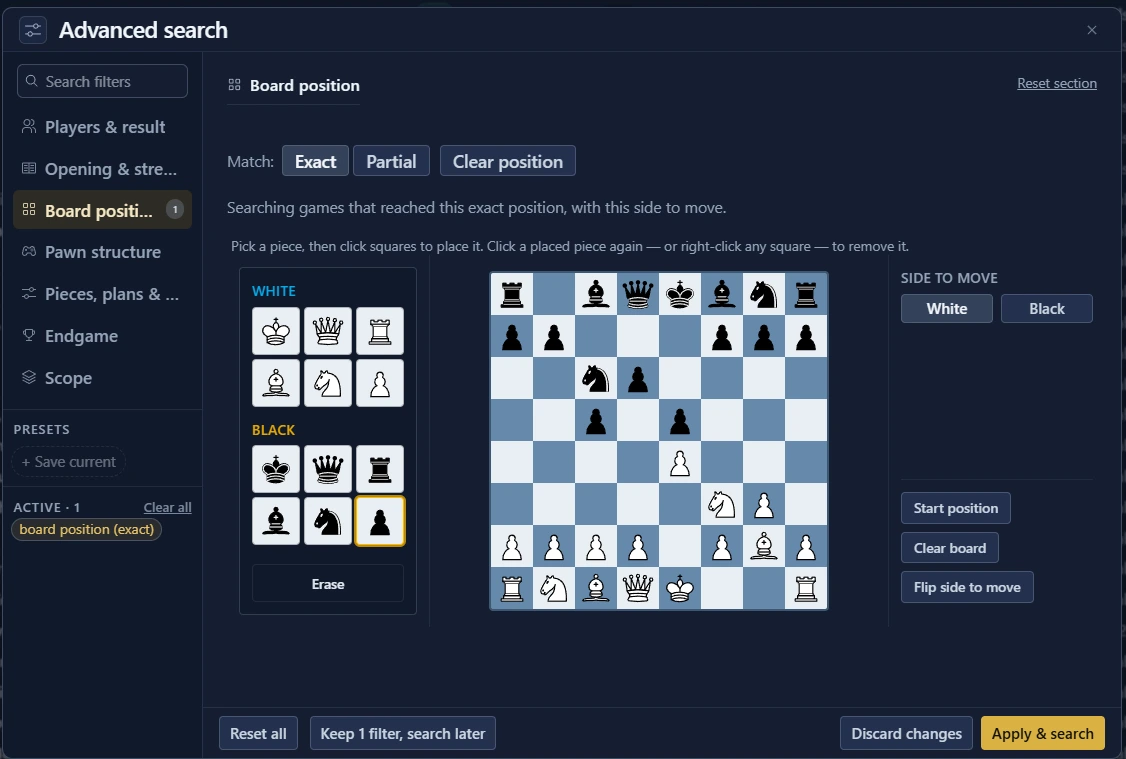
Take the position after 1.e4 c6 2.d4 d5 3.exd5 cxd5 4.c4 Nf6 5.Nc3 e6, the Panov. Six moves in, you're somewhere the Nimzo and the Queen's Gambit also reach by their own routes. An opening explorer treats those as three different places, because an explorer follows move orders. Position search doesn't care how anyone arrived. It keys on the pieces, and pulls every game that stood where you're standing.
That difference decides what each tool is for. Walk theory forward with the explorer. Use position search when you're in a position and want precedent: who's had this, what they played, how it went.
The workflow
- Get the position in front of you. Play to it, set it up on the board, or stop at it mid-review.
- Search it. In FlexiChess that's one item on the board menu, Search position in FlexiBase, and it runs against 10.4 million tournament games. Give it a few seconds.
- What comes back is games, with who played them, when, and how it ended. Open two or three. You're after the plan, which rook comes to the file, which minor piece gets traded, when the thematic break lands, and a plan only shows itself across a few games.
- For the reply split, the opening explorer beside the board has it for any position the book covers: each move, how often it was played, and how White, Black and the draws came out. A move played 400 times scoring 54% is the mainline for a reason. A move played 12 times scoring 70% is either an idea nobody's noticed or twelve games against weak opposition. Open a few and see who was playing it.
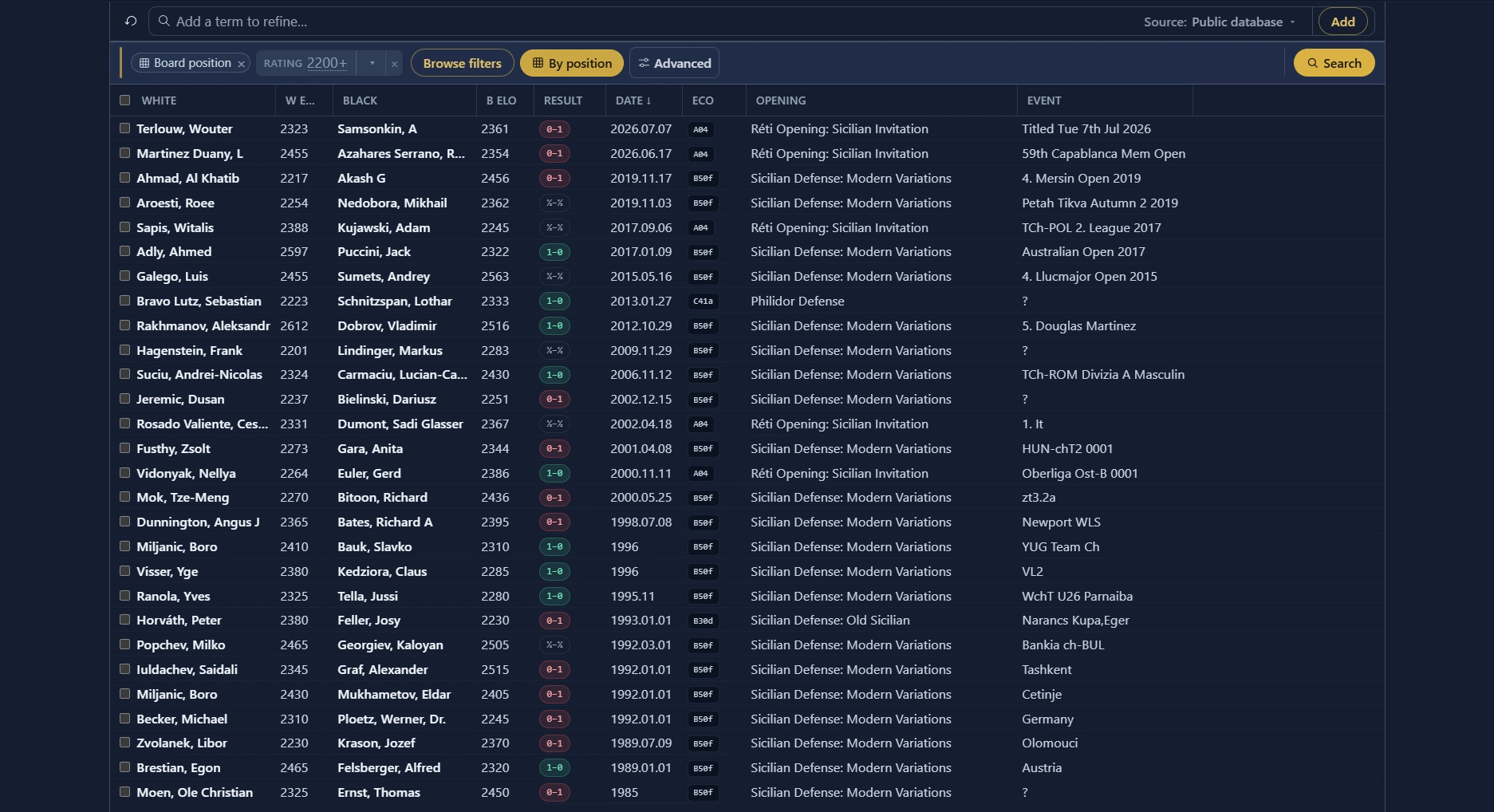
- Set the rating floor to match your question. Type 2700+ and you get the theoretical verdict. Leave it open and you see how the position actually goes wrong in practice, which is often the more useful answer, because your next opponent isn't a 2700.
Why database size decides whether this works at all
Any database covers the mainlines. The payoff is ten moves past theory, where your prep runs out, and there sample size is everything. A few hundred thousand games go silent the moment your position gets rare. Millions keep answering. That's why FlexiChess indexes 10.4 million games, club to world championship, rather than a curated elite slice. Sometimes the answer you need is how 2100s mishandle the position, because that's what will happen to you over the board.
Position search is free, no account. Put a position on the board and ask. Open FlexiChess →
Related: How to scout a chess opponent's openings · How to study your own chess games
← All posts