
September 5, 2026
How to scout a chess opponent's openings before a game
Andrew
Pairings are up. Your opponent is a name and a rating, and you have one evening. Don't spend it on theory, spend it on them. Preparation only pays if it appears on the board, and the only lines that appear are the ones your opponent chooses.
Get a couple of hundred of their games. Online handles, federation archives, a teammate's PGN. A few dozen games is noise dressed up as a tendency. Somewhere past two hundred the picture stops changing.
Treat White and Black as two different opponents. Walk each colour back to the first real decision. Against 1.e4, is it the Sicilian, the Caro, 1...e5? As White, one fixed system or a mix? You're building a small tree weighted by how often each branch actually gets played, and your prep lands on the fat branches.
Weight lines by frequency, pick targets by score. A line they play 40% of the time and score 30% in is a target. A line they play 40% of the time and win with is a warning. Same frequency, opposite conclusion, which is why counting games without counting results scouts nothing.
Chase the positions. If three different move orders all funnel them into the same isolated-queen-pawn middlegame, that position is their repertoire, whatever they call the opening. Find the structures they keep steering toward and prepare against those.
Convert it into one decision, then stop. "I meet their Sicilian with the line that lands in the structure they score worst in." Written down, specific, done. Scouting past midnight is procrastination with a chessboard on the screen.
The same evening, in minutes
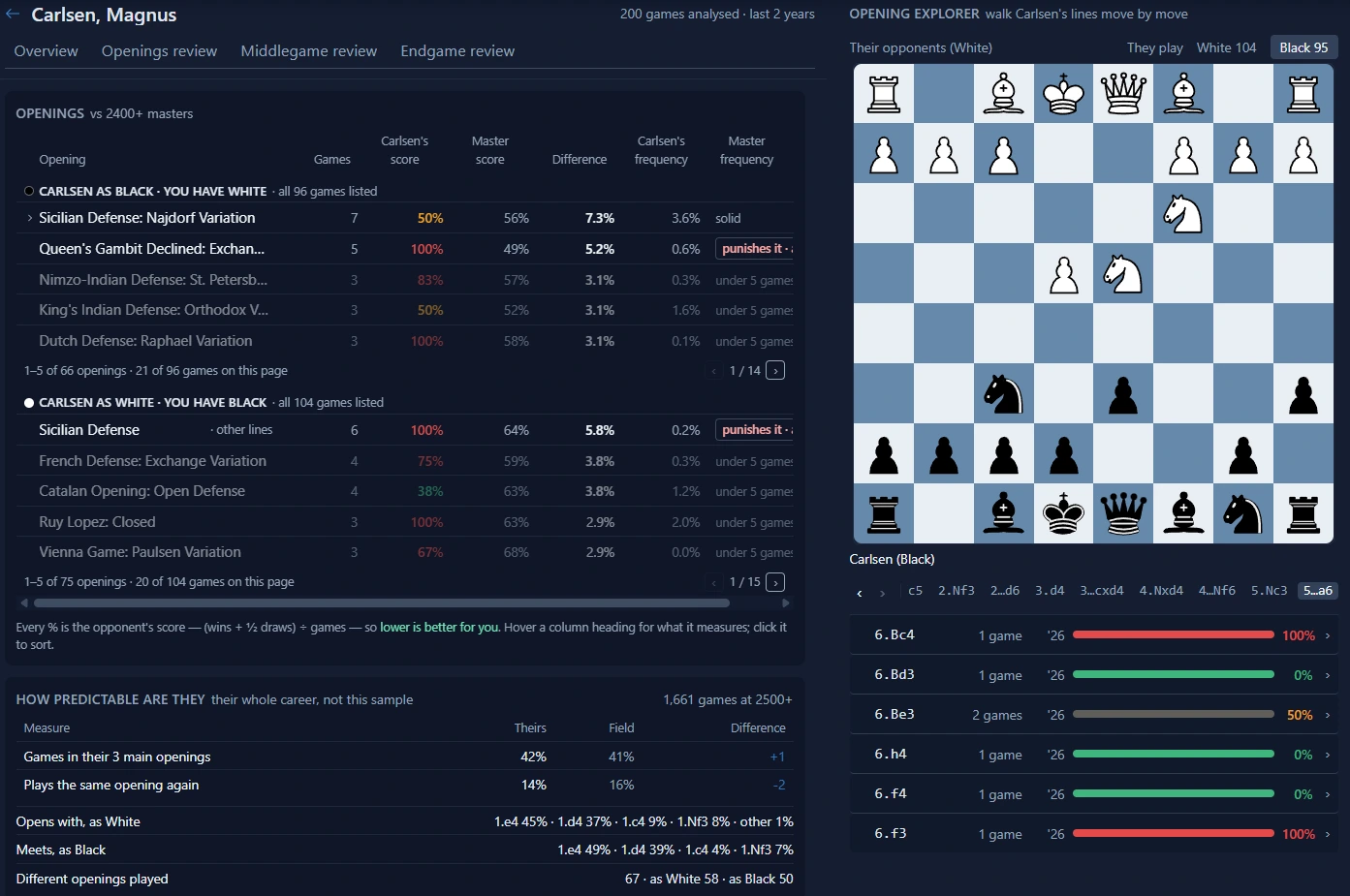
Analyze player in FlexiChess runs this for you. Name a player in the database, give it a Lichess or Chess.com handle, or point it at a database in your library, and it reads their games by colour: the openings and the structures they actually reach, how they score there, and how they handle each kind of ending. Every score sits next to what 2400+ players make in the same lines, so a 45% reads as good or bad without you doing the arithmetic. It won't run off fewer than 200 games, for the reason above, and with an account it goes to a thousand or their whole career. Free with a FlexiChess account, a thousand a month. And because the same workbench searches 10.4 million tournament games by position, you can check straight away how strong players handle the structures your opponent relies on.
Try it: Open Analyze player →
Related: How to search any chess position across millions of tournament games · How to study your own chess games
← All posts