
October 31, 2026
What a chess engine eval graph actually tells you
Andrew
The number is in pawns, from White's side. +1.0 is a pawn's worth of advantage under best play from both sides, 0.00 is equal, and #+5 is forced mate in five, not a pawn count. Everyone knows this much. The useful reading starts with the shape.
A cliff is a mistake and a slope is a lesson. The sharp drop is the move you'd have found anyway. The slow drift across eight moves, no single bad move, just a position getting worse, is strategic failure, and it's the most valuable thing on the graph precisely because you couldn't feel it happening. When you review, the drifts deserve more time than the cliffs.
Find where the game was actually decided. A long flat line and then a swing on move 31 means everything before that was noise, including the "critical" middlegame you agonized over. Point your study time at the swing.
Four traps worth naming, because they cost real rating:
- Eval says nothing about difficulty. +0.5 can be trivial to convert or nearly impossible for a human to hold. The number rates the position, not the task.
- "Best play" carries the whole claim. A +2.0 that requires six only-moves in a row is, between humans, close to a coin flip. Don't resign yourself to a number you'd never be asked to defend.
- Let the depth settle. The engine's first opinion flips more often than its tenth. A snap eval at low depth is a rumour.
- Accuracy compares you to the engine in the positions you reached. 95% in a quiet game is easy and 80% in a sharp one can be excellent. Comparing accuracy across different games tells you which game was quieter, not which you played better.
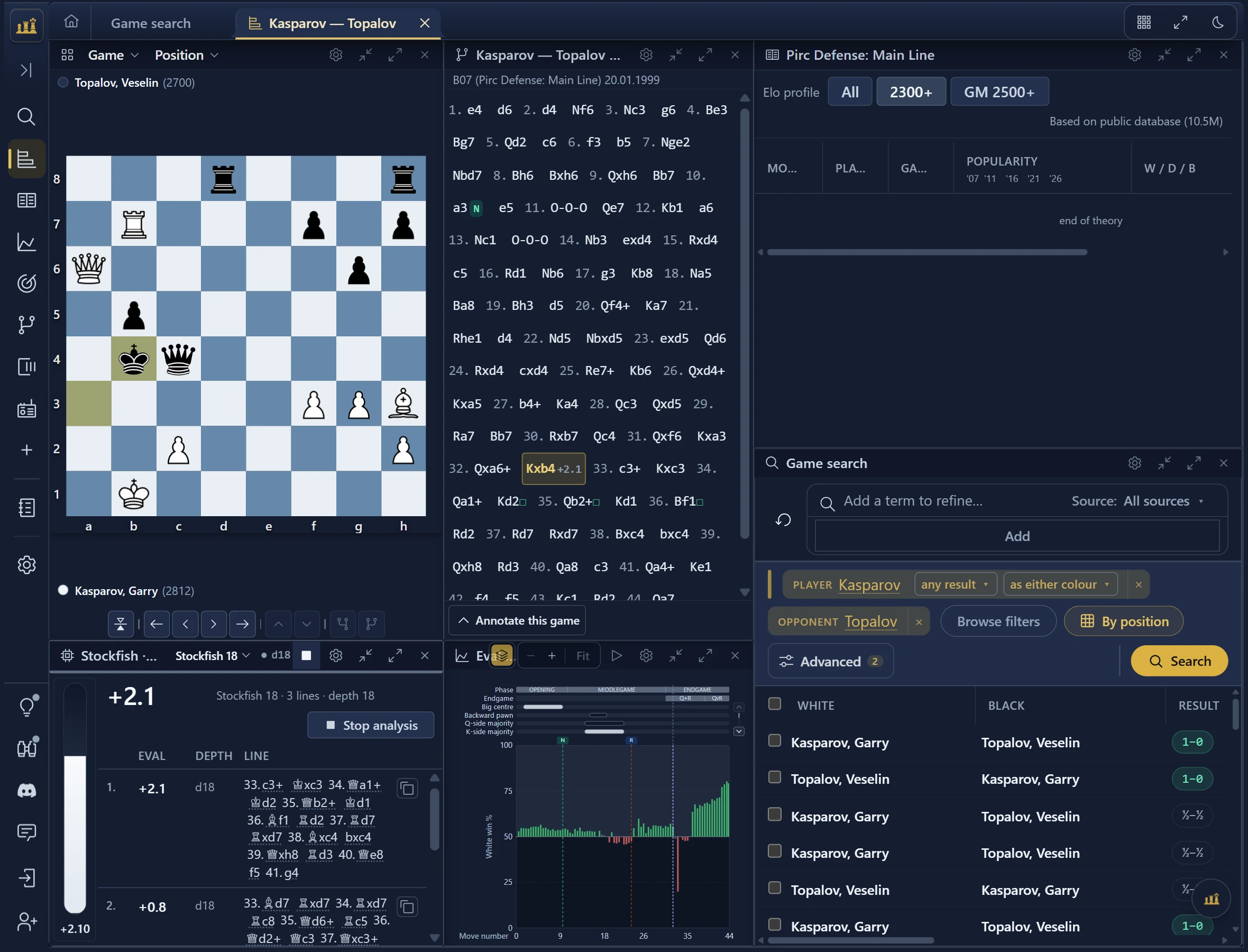
Use the graph as a map. Cliffs and drifts mark the positions worth your time, and the actual work happens at those positions, which usually means checking them against real games. In FlexiChess the graph, multi-line Stockfish and the move labels are free with no account, and Review game adds an accuracy figure per side and per phase, which is where trap four shows up in your own games. Click any point on the graph and the board goes there, and from the board one menu item searches that position across 10.4 million tournament games. The full review loop is its own post.
Try it: Run the graph on your own game, free. Open FlexiChess →
Related: How to study your own chess games · How to search any chess position across millions of tournament games
← All posts